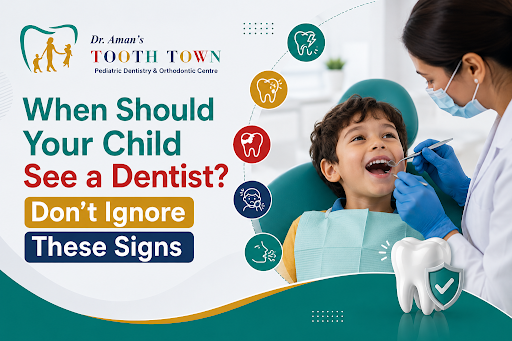
Your child says a tooth “feels funny,” then finishes dinner and runs off to play. The complaint is easy to dismiss, especially when the tooth is a baby tooth, or there is no obvious cavity. But children do not always describe dental pain clearly. They may chew on one side, avoid cold food, wake at night, or become unusually resistant to brushing instead.
Many general dentists provide excellent care for children. The point is not that every child must leave a family dentist. A pediatric dentist becomes particularly useful when the problem involves developing teeth, dental fear, repeated decay, an injury, a persistent oral habit or a medical or sensory need that changes how care should be delivered.
A pediatric dentist, sometimes called a kids dentist, receives focused training in children’s oral health, growth and development, behaviour guidance and age-appropriate treatment. The Indian Society of Pedodontics and Preventive Dentistry describes pediatric dentists as specially trained to care for the teeth, gums and mouths of children from infancy through adolescence.
If you are deciding whether to consult a kids dentist in Vasant Vihar, the following signs can help you judge when a child-specific assessment may be worthwhile.
A brief complaint after biting something hard is different from pain that returns, wakes a child at night, or affects eating. Watch for less obvious changes too:
Toothache may be caused by decay, a crack, an erupting tooth, gum inflammation, or infection. A pediatric dentist can adapt the examination to the child’s age and communication level rather than relying only on the child to explain where it hurts.
Do not repeatedly cover up dental pain with home remedies. Relief does not mean the cause has gone away.
Parents often look for a dark hole when checking for cavities. Early decay can be less obvious. A chalky white patch, particularly near the gumline, may be an early change in the enamel. As decay progresses, the area may turn brown or black, form a pit or begin trapping food.
The American Dental Association explains that an early cavity can appear as a white spot before becoming brown or black. Some early enamel changes may be managed without drilling, depending on what the dentist finds. A visible hole usually requires a different approach.
Book an assessment even if the tooth does not hurt. Children can have active decay before they report pain, and baby teeth still support chewing, speech and the space needed by developing permanent teeth.
A small bump on the gum beside a tooth may be a drainage point from an infection. Other warning signs include gum or facial swelling, a bad taste, worsening pain, difficulty chewing, fever or a child who appears unwell.
A suspected dental abscess needs urgent dental assessment. The NHS guidance on dental abscesses notes that an abscess does not resolve on its own and may cause tooth or gum pain, facial swelling and fever.
Seek emergency medical help if facial swelling is spreading, reaching the eye, or making it difficult for the child to breathe, swallow or open the mouth. Antibiotics may sometimes be prescribed when an infection is spreading, but they do not replace treatment of the affected tooth.
Falls, playground accidents and sports injuries can damage a tooth even when bleeding stops quickly. A tooth may be cracked, loosened, pushed inward or completely knocked out. The correct response depends on whether it is a baby tooth or a permanent tooth, so guessing can make the situation harder.
Contact a dentist promptly after a dental injury. For a knocked-out permanent tooth, time matters. Dental-emergency guidance from the American Dental Association advises keeping the tooth moist, avoiding contact with the root and reaching a dentist immediately. Do not try to push a knocked-out baby tooth back into its socket; primary-tooth injuries are managed differently.
A pediatric dentist is familiar with both the injured tooth and the developing permanent tooth beneath or around it. Follow-up may be needed even when the child feels better, because some complications appear later.
Children do not all lose and gain teeth on the same date. However, a dental review is sensible when:
The issue is not always serious. Sometimes observation is all that is required. In other cases, early loss can allow nearby teeth to drift into the empty space, or an eruption problem may need imaging and monitoring. Current AAPD guidance on developing dentition includes space management, ectopic eruption, missing or extra teeth and other developmental concerns.
Front teeth that do not meet, a lower tooth sitting outside an upper tooth, marked crowding or a jaw that appears to shift when the child closes can all justify an assessment. Your child may also bite the cheek frequently, struggle to tear food or avoid certain textures.
Not every uneven bite requires immediate treatment. A pediatric dentist can examine the child’s present stage of growth, monitor how the permanent teeth are arriving and decide whether observation, an interceptive step or an orthodontic opinion makes sense.
This is one area where timing matters. “Wait until every adult tooth arrives” is not the right answer for every bite problem, but starting treatment early is not automatically better either. The decision should follow a proper diagnosis.
Sucking habits are common and often stop naturally. Concern increases when a habit continues as permanent teeth begin to emerge or when you can see changes such as front teeth no longer meeting, upper teeth tilting forward or a recurring gap when the child bites.
Scolding usually makes the situation more stressful. A kids' dentist can look at the habit’s frequency, intensity, and effect on the teeth, then suggest an age-appropriate plan. That may involve reassurance and monitoring, positive reminders, identifying triggers or, in selected cases, an appliance.
The goal is not to make the child feel guilty. It is to understand whether the habit is affecting oral development and choose the least intrusive helpful response.
Some nervousness before a dental appointment is normal. Specialist support may help when a child repeatedly refuses to enter the clinic, cannot tolerate anyone looking in the mouth, gags or panics during simple care, or has had a difficult previous experience.
Pediatric behaviour guidance is more than distraction. It may include tell-show-do, simple choices, desensitisation, positive reinforcement and appointment pacing based on the child’s developmental level. The AAPD’s behaviour-guidance recommendations emphasise communication, anxiety reduction and building a positive dental attitude.
Tell the clinic about your child’s fear before the appointment. This gives the team time to plan the visit instead of discovering the problem after the child is already overwhelmed.
A child with autism, ADHD, a sensory-processing difference, a physical disability, a bleeding condition, heart disease, epilepsy or another health concern may need adjustments to the appointment or coordination with a medical professional.
Those adjustments can include a quieter time of day, a gradual familiarisation visit, different communication methods, extra appointment time, attention to positioning or a review of medicines and medical precautions. The AAPD’s guidance for patients with special health care needs recognises that physical, developmental, sensory, behavioural, cognitive and emotional conditions may require specialised services.
Bring the child’s medication list, relevant reports and treating doctor’s details. Do not stop or alter prescribed medicine unless the appropriate clinician advises it.
If a child develops new cavities soon after treatment, the answer is not simply another filling. Repeated decay calls for a fresh look at why the disease remains active.
A pediatric dental assessment may review:
This is called caries-risk assessment. The prevention plan should be personalised rather than assuming that every child needs the same appointment schedule or treatment. Tooth Town also provides information about cavity prevention for children, including fluoride and preventive care.
Some concerns can wait for a planned consultation; others should not.
| What you notice | What to do |
|---|---|
| Spreading facial swelling, difficulty breathing or swallowing, swelling near the eye, or a very unwell child | Seek emergency medical care immediately and arrange urgent dental care |
| A knocked-out permanent tooth | Contact a dentist immediately; keep the tooth moist and hold it by the crown, not the root |
| Severe pain, local swelling, fever, a gum pimple or a suspected abscess | Request an urgent dental appointment |
| White or dark spots, altered bite, persistent oral habits, eruption concerns or recurring cavities | Book a dental assessment soon rather than waiting for pain |
When you call, describe the symptom, when it began, whether there is swelling or fever and whether the tooth is a baby or permanent tooth if you know.
General dentists and pediatric dentists can both contribute to a child’s oral health. The practical difference is the specialist’s additional focus on children.
A pediatric dentist is trained to consider:
At Tooth Town, Dr. Amandeep Singh holds a master’s degree in paediatric dentistry and has undertaken further training at AIIMS New Delhi, according to his clinic profile. That background is directly relevant when a child’s dental problem needs more than an adult-style appointment made shorter.
The absence of pain does not mean a child should never see a dentist. The AAPD recommends establishing a dental home by 12 months of age. An early visit is usually about risk assessment, brushing, feeding habits, teething questions and helping the child become familiar with dental care.
After that, the interval between visits should reflect the child’s individual risk and clinical needs. The AAPD commonly recommends six-month check-ups, but a dentist may suggest a different schedule for a particular child.
If your child has recurring pain, visible tooth changes, a dental injury, strong dental fear or a developmental concern, a child-focused assessment can clarify what is happening and how urgently it needs attention.
Tooth Town provides access to a pediatric dentist in Vasant Vihar at 38, Lower Ground Floor, Poorvi Marg, Vasant Vihar, New Delhi. Contact the clinic, explain what you have noticed and ask whether your child needs a routine, early or urgent appointment.
This article provides general educational information and cannot diagnose your child. Treatment and appointment timing should be decided after an examination by a qualified dental professional. Seek urgent medical help for breathing or swallowing difficulty, rapidly spreading facial swelling or a seriously unwell child.
Both complete dental training, and many general dentists treat children well. A pediatric dentist completes additional specialist education focused on infants, children and adolescents, including growth and development, behaviour guidance, dental trauma and special health care needs.
Professional pediatric-dentistry guidance recommends establishing a dental home no later than the child’s first birthday. A child should be seen sooner if a tooth erupts and the parent notices an injury, unusual change or other concern.
Yes. The treatment depends on the tooth, the extent of decay and how long the tooth is expected to remain. Untreated decay can cause pain or infection, and baby teeth help with chewing, speech and maintaining space for permanent teeth.
Yes. Pediatric dentists use age-appropriate communication and behaviour-guidance methods. Tell the clinic about previous experiences, triggers, sensory needs and what usually helps your child before the visit.
No. Some alignment changes are normal while teeth are being replaced. A dentist should examine the bite, eruption pattern and jaw growth before deciding whether to observe, intervene or refer for an orthodontic assessment.
2017 © Tooth Town - All Rights Reserved.